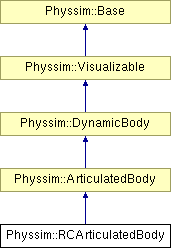
#include <RCArticulatedBody.h>
Inheritance diagram for Physsim::RCArticulatedBody:
Public Member Functions | |
| RCArticulatedBody () | |
| Default constructor. | |
| RCArticulatedBody (const RCArticulatedBody &source) | |
| Copy constructor. | |
| virtual void | clone (BasePtr &cloned, bimap< BasePtr, BasePtr > *obj_map=NULL) const |
| Clones this body. | |
| virtual bool | is_struct_identical (BaseConstPtr object) const |
| Verifies that two object structures are identical. | |
| virtual void | load_state (BaseConstPtr object, bimap< BasePtr, BasePtr > *correspondence=NULL) |
| Loads this object with data from a RCArticulatedBody object. | |
| virtual void | save_state (BasePtr object, bimap< BasePtr, BasePtr > *correspondence=NULL) const |
| Save this to a RCArticulatedBody object. | |
| void | set_links (const std::vector< RigidBodyPtr > &links) |
| Sets the list of articulated links. | |
| RigidBodyPtr | find_link (const std::string &linkname) const |
| Finds the link with the given name. | |
| JointPtr | find_joint (const std::string &jointname) const |
| Finds the joint with the given name. | |
| void | add_link (RigidBodyPtr link) |
| Appends a link to the list of links. | |
| virtual VectorN | get_state_deriv () |
| Gets the derivative of the state-vector for this articulated body. | |
| virtual VectorN | get_state () |
| Gets the state vector for this articulated body. | |
| virtual void | set_state (const VectorN &state) |
| Sets the state vector this articulated body. | |
| MatrixN | calc_jacobian_column (JointPtr joint, const Vector3 &point) |
| Calculates column(s) of a Jacobian matrix. | |
| MatrixNN | calc_jacobian_floating_base (const VectorN &point) |
| Calculates the column of a Jacobian matrix for a floating base with respect to a given point. | |
| virtual std::list< RigidBodyPtr > | get_rigid_bodies () const |
| Gets the list of links as rigid body objects. | |
| virtual void | reset_accumulators () |
| Resets the force and torque accumulators for all links and joints in the rigid body. | |
|
virtual std::list< sorted_pair< RigidBodyPtr > > | get_adjacent_links () const |
| Retrieves all adjacent links as pairs of rigid bodies. | |
| void | add_joint (JointPtr joint) |
| Appends a joint to the list of joints. | |
| void | set_joints (const std::vector< JointPtr > joints) |
| Sets the list of joints. | |
| void | update_link_transforms () const |
| Updates the transforms of the links based on the current joint positions. | |
| void | update_link_velocities () |
| Updates the link velocities. | |
| void | apply_impulse (const Vector3 &j, const Vector3 &k, const Vector3 &p, RigidBodyPtr link) |
| Applies a linear impulse at the specified point and propagates it up the articulated body chain. | |
| virtual void | compile () |
| Compiles this body (updates the link transforms and velocities). | |
| virtual void | calc_fwd_dyn () |
| Computes the forward dynamics. | |
| virtual void | update_visualization () |
| Synchronizes the visualization for all links and joints of this body to their corresponding transforms. | |
| virtual void | load_from_xml (XMLTreeConstPtr node, std::map< std::string, BasePtr > &id_map) |
| Implements Base::load_from_xml(). | |
| virtual void | save_to_xml (XMLTreePtr node, std::list< BaseConstPtr > &shared_objects) const |
| Implements Base::save_to_xml(). | |
| RCArticulatedBodyPtr | get_this () |
| RCArticulatedBodyConstPtr | get_this () const |
| virtual bool | joint_limit_collision (Real collision_tolerance) const |
| Abstract method for determining whether or not there is a collision at the joint-limit. | |
| virtual void | correct_joint_limit_collisions (Real collision_tolerance) |
| Abstract method for correcting joint limit collisions. | |
| virtual void | correct_joint_limit_violations () |
| Abstract method for correcting joint limit violations. | |
| RigidBodyPtr | get_base_link () const |
| Gets the base link. | |
| const std::vector< RigidBodyPtr > & | get_links () const |
| Gets the list of links; the base is the first link. | |
| const std::vector< JointPtr > & | get_joints () const |
| Gets the list of joints. | |
| bool | is_floating_base () const |
| Gets whether this articulated body uses a floating base. | |
| void | set_floating_base (bool flag) |
| Sets whether this articulated body uses a floating base. | |
| RigidBodyPtr | get_base () const |
| Gets the base link. | |
| void | set_computation_ref_frame (ReferenceFrameType type) |
| Sets the reference frame for computation. | |
| ReferenceFrameType | get_computation_ref_frame () const |
| Gets the reference frame for computation. | |
| boost::shared_ptr< RCArticulatedBodyFwdDynAlgo > | get_forward_dynamics_algorithm () const |
| Gets the algorithm for forward dynamics computation. | |
| void | set_forward_dynamics_algorithm (boost::shared_ptr< RCArticulatedBodyFwdDynAlgo > algorithm) |
| Sets the algorithm for forward dynamics computation. | |
Reduced-coordinate articulated bodies cannot rely upon the integrator to automatically update the states (i.e., positions, velocities) of the links, as is done with maximal-coordinate articulated bodies. Rather, the integrator updates the joint positions and velocities; the states are obtained from this reduced-coordinate representation. Notes about concurrency:
It is generally desirable to be able to run forward dynamics and inverse dynamics algorithms concurrently to simulate actual robotic systems. In general, derived classes should not operate on state variables (joint positions, velocities, accelerations and floating base positions, velocites, and accelerations) directly during execution of the algorithm. Rather, derived classes should operate on copies of the state variables, updating the state variables on conclusion of the algorithms.
| RCArticulatedBody::RCArticulatedBody | ( | ) |
Default constructor.
Constructs a reduced-coordinate articulated body with no joints and no links.
| void RCArticulatedBody::clone | ( | BasePtr & | cloned, | |
| bimap< BasePtr, BasePtr > * | object_map = NULL | |||
| ) | const [virtual] |
Clones this body.
Performs a shallow copy of the underlying collision geometry and visualization data.
Reimplemented from Physsim::Visualizable.
| void RCArticulatedBody::load_state | ( | BaseConstPtr | object, | |
| bimap< BasePtr, BasePtr > * | correspondence = NULL | |||
| ) | [virtual] |
Loads this object with data from a RCArticulatedBody object.
This and the clone must have exactly the same structure (i.e., same number of links, joints, one/none parent link, and one/none inner joint; additionally, child links, parent link (if any), and inner joint (if any) must have the same structure.
Reimplemented from Physsim::Visualizable.
| void RCArticulatedBody::save_state | ( | BasePtr | object, | |
| bimap< BasePtr, BasePtr > * | correspondence = NULL | |||
| ) | const [virtual] |
Save this to a RCArticulatedBody object.
This and the clone must have exactly the same structure (i.e., same number of links, joints, one/none parent link, and one/none inner joint; additionally, child links, parent link (if any), and inner joint (if any) must have the same structure.
Reimplemented from Physsim::Visualizable.
| RigidBodyPtr RCArticulatedBody::find_link | ( | const std::string & | linkname | ) | const |
Finds the link with the given name.
| JointPtr RCArticulatedBody::find_joint | ( | const std::string & | jointname | ) | const |
Finds the joint with the given name.
| VectorN RCArticulatedBody::get_state_deriv | ( | ) | [virtual] |
Gets the derivative of the state-vector for this articulated body.
The state vector consists of the joint-space positions and velocities of the robot as well as the base position and momentum; therefore, the derivative of the state vector is composed of the joint-space velocities and accelerations and base velocities and forces (and torques).
Implements Physsim::ArticulatedBody.
| VectorN RCArticulatedBody::get_state | ( | ) | [virtual] |
Gets the state vector for this articulated body.
The state vector consists of the joint-space positions and velocities of the robot and base positions and momenta.
Implements Physsim::ArticulatedBody.
| void RCArticulatedBody::set_state | ( | const VectorN & | state | ) | [virtual] |
Sets the state vector this articulated body.
The state vector consists of the joint-space positions and velocities of the robot and base positions and momenta. Note that this method is responsible for setting the transforms of the individual links as well.
Implements Physsim::ArticulatedBody.
Calculates the column of a Jacobian matrix for a floating base with respect to a given point.
| point | the point in 3D space which the Jacobian is calculated against |
| std::list< RigidBodyPtr > RCArticulatedBody::get_rigid_bodies | ( | ) | const [virtual] |
Gets the list of links as rigid body objects.
Needed for implementation of ArticulatedBody::get_rigid_bodies().
Implements Physsim::ArticulatedBody.
| void RCArticulatedBody::update_link_transforms | ( | ) | const |
Updates the transforms of the links based on the current joint positions.
| void RCArticulatedBody::apply_impulse | ( | const Vector3 & | j, | |
| const Vector3 & | k, | |||
| const Vector3 & | contact_point, | |||
| RigidBodyPtr | link | |||
| ) | [virtual] |
Applies a linear impulse at the specified point and propagates it up the articulated body chain.
| j | the linear impulse | |
| k | the angular impulse | |
| contact_point | the point of collision | |
| link | the link that the impulse is applied to | |
| fsab_algo | if non-null, already computed quanities from dynamics algorithm will be used; otherwise, forward dynamics algorithm will be called using FSAB algorithm |
Implements Physsim::ArticulatedBody.
| void RCArticulatedBody::calc_fwd_dyn | ( | ) | [virtual] |
Computes the forward dynamics.
Given the joint positions and velocities, joint forces, and external forces on the links, determines the joint and link accelerations as well as floating base accelerations (if applicable). The joint accelerations are stored in the individual joints and the link accelerations are stored in the individual links.
Implements Physsim::DynamicBody.
| void RCArticulatedBody::load_from_xml | ( | XMLTreeConstPtr | node, | |
| std::map< std::string, BasePtr > & | id_map | |||
| ) | [virtual] |
Implements Base::load_from_xml().
Reimplemented from Physsim::Visualizable.
| void Physsim::RCArticulatedBody::set_computation_ref_frame | ( | ReferenceFrameType | type | ) | [inline] |
Sets the reference frame for computation.
 1.5.1
1.5.1