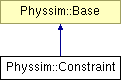
#include <Constraint.h>
Inheritance diagram for Physsim::Constraint:
Public Member Functions | |
| virtual void | read (const char *filename)=0 |
| virtual void | write (const char *filename)=0 |
| int | getBodyIndex (const RigidBody *body) const |
| Gets the index of a body in the given list. | |
| bool | isEnabled () const |
| Determines whether this constraint is currently enabled. | |
| void | setEnabled (bool flag) |
| Sets whether this constraint is currently enabled. | |
| virtual std::string | getJointType () const=0 |
| Gets the type of the constraint. | |
| RigidBody * | getBodyFirst () const |
| Gets the pointer to the first rigid body managed by this constraint; if the pointer is NULL, the body is constrained to the environment. | |
| RigidBody * | getBodySecond () const |
| Gets the pointer to the second rigid body managed by this constraint; if the pointer is NULL, the body is constrained to the environment. | |
| void | setBodies (const RigidBody *body1, const RigidBody *body2) |
| Sets both rigid bodies managed by this constraint. | |
| Vector3 | getBodyFirstTorque () const |
| Gets the torque that would be applied to the first body by this constraint. | |
| Vector3 | getBodyFirstForce () const |
| Gets the force that would be applied to the first body by this constraint. | |
| Vector3 | getBodySecondTorque () const |
| Gets the torque that would be applied to the second body by this constraint. | |
| Vector3 | getBodySecondForce () const |
| Gets the force that would be applied to the second body by this constraint. | |
| void | setBodyFirstTorque (const Vector3 &torque) |
| Sets the torque that would be applied to the first body by this constraint. | |
| void | setBodyFirstForce (const Vector3 &force) |
| Sets the force that would be applied to the first body by this constraint. | |
| void | setBodySecondTorque (const Vector3 &torque) |
| Sets the torque that would be applied to the second body by this constraint. | |
| void | setBodySecondForce (const Vector3 &force) |
| Sets the force that would be applied to the second body by this constraint. | |
| Real | getMaxForce () const |
| Gets the magnitude of the maximum possible force that this constraint can apply. | |
| Real | getMaxTorque () const |
| Gets the magnitude of the maximum possible torque that this constraint can apply. | |
| void | setMaxForce (Real maxforce) |
| Sets the magnitude of the maximum possible force that this constraint can apply. | |
| void | setMaxTorque (Real maxtorque) |
| Sets the magnitude of the maximum possible torque that this constraint can apply. | |
| virtual Real | getImplicit (const std::vector< RigidBody * > body_list) const=0 |
| Gets the value of the scalar implicit function for this constraint. | |
| virtual Real | getImplicitD (const std::vector< RigidBody * > body_list) const=0 |
| Gets the value of the derivative of the scalar implicit function for this constraint. | |
| virtual VectorN | getJacobian (const std::vector< RigidBody * > body_list) const=0 |
| Gets the Jacobian of the constraint. | |
| virtual VectorN | getJacobianD (const std::vector< RigidBody * > body_list) const=0 |
| Gets the derivative of the Jacobian of the constraint. | |
| Real | getKP () const |
| Gets the value of the spring drift-correction term. | |
| void | setKP (Real kp) |
| Sets the value of the spring drift-correction term. | |
| Real | getKD () const |
| Gets the value of the damper drift-correction term. | |
| void | setKD (Real kd) |
| Sets the value of the damper drift-correction term. | |
Protected Attributes | |
| RigidBody * | _body1 |
| Pointer to the first body. | |
| RigidBody * | _body2 |
| Pointer to the second body. | |
| Vector3 | _f1 |
| Force applied by this constraint to the first body. | |
| Vector3 | _t1 |
| Torque applied by this constraint to the first body. | |
| Vector3 | _f2 |
| Force applied by this constraint to the second body. | |
| Vector3 | _t2 |
| Torque applied by this constraint to the second body. | |
| Real | _kp |
| Spring constant used to correct numerical drift. | |
| Real | _kd |
| Damper constant used to correct numerical drift. | |
| Real | _maxforce |
| Magnitude of the maximum possible force that this constraint can apply. | |
| Real | _maxtorque |
| Magnitude of the maximum possible torque that this constraint can apply. | |
This class will be replaced completely by the Joint class, which will implement constraints for both reduced and maximal-coordinate articulated bodies.
| int Physsim::Constraint::getBodyIndex | ( | const RigidBody * | body | ) | const |
Gets the index of a body in the given list.
Sets both rigid bodies managed by this constraint.
Note that if either body is NULL, then the other body is constrained to the environment. If both bodies are NULL, the constraint is effectively disabled (though it is more efficient to set the constraint to disabled via setEnabled().
| virtual Real Physsim::Constraint::getImplicit | ( | const std::vector< RigidBody * > | body_list | ) | const [pure virtual] |
Gets the value of the scalar implicit function for this constraint.
In ideal circumstances, this method will return zero. In the presence of drift, however, the value will be nonzero. This method, as well as getImplicitD(), is used to enforce the constraints via a spring and damper system.
| virtual Real Physsim::Constraint::getImplicitD | ( | const std::vector< RigidBody * > | body_list | ) | const [pure virtual] |
Gets the value of the derivative of the scalar implicit function for this constraint.
In ideal circumstances, this method will return zero. In the presence of drift, however, this value will be nonzero. This method, as well as getImplicit(), is used to enforce the constraints via a spring and damper system.
| virtual VectorN Physsim::Constraint::getJacobian | ( | const std::vector< RigidBody * > | body_list | ) | const [pure virtual] |
Gets the Jacobian of the constraint.
The the Jacobian is a row-vector of dimension N*3, where N is the number of bodies in the system.
| virtual VectorN Physsim::Constraint::getJacobianD | ( | const std::vector< RigidBody * > | body_list | ) | const [pure virtual] |
Gets the derivative of the Jacobian of the constraint.
The derivative of the Jacobian is a row-vector of dimension N*3, where N is the number of bodies in the system.
 1.5.1
1.5.1