#include <CollisionGeometry.h>
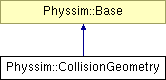
Inheritance diagram for Physsim::CollisionGeometry:
Public Member Functions | |
| CollisionGeometry () | |
| Constructs a CollisionGeometry with no triangle mesh, identity transformation and relative transformation. | |
| CollisionGeometryPtr | get_child (unsigned i) const |
| Gets the 0-indexed child of this CollisionGeometry. | |
| virtual void | clone (BasePtr &cloned, bimap< BasePtr, BasePtr > *obj_map=NULL) const |
| Clones this collision geometry. | |
| virtual void | load_state (BaseConstPtr object, bimap< BasePtr, BasePtr > *correspondence=NULL) |
| Loads the state of this geometry from another CollisionGeometry object. | |
| virtual void | save_state (BasePtr object, bimap< BasePtr, BasePtr > *correspondence=NULL) const |
| Saves the state of this body to another CollisionGeometry object with the same structure. | |
| bool | is_struct_identical (BaseConstPtr object) const |
| Verifies that the structure is identical between two CollisionGeometry objects. | |
| void | set_transform (const Matrix4 &transform, bool rel_transform_accounted) |
| Sets the transform of this CollisionGeometry. | |
| void | write_vrml (const std::string &filename) const |
| Writes the collision geometry mesh to the specified VRML file. | |
| void | set_geometry (PrimitiveConstPtr primitive) |
| Sets the collision geometry via a primitive. | |
| void | set_rel_transform (const Matrix4 &transform) |
| Sets the relative transform (from its parent CollisionGeometry or dynamic body) for this CollisionGeometry. | |
| std::list< CollisionGeometryPtr > | get_sub_geometries () const |
| Gets all descendant collision geometries (unordered). | |
| virtual void | save_to_xml (XMLTreePtr node, std::list< BaseConstPtr > &shared_objects) const |
| Implements Base::save_to_xml(). | |
| virtual void | load_from_xml (XMLTreeConstPtr node, std::map< std::string, BasePtr > &id_map) |
| Implements Base::load_from_xml(). | |
| void | set_max_tri_area (Real area) |
| Sets the maximum triangle area for this geometry's mesh. | |
| Real | get_max_tri_area () const |
| Gets the maximum triangle area for the collision mesh. | |
| TriangleArrayConstPtr | get_mesh () const |
| Gets the collision mesh. | |
| boost::weak_ptr< CollisionGeometry > | get_parent () const |
| Gets the parent of this CollisionGeometry (or NULL if there is no parent). | |
| void | set_parent (boost::weak_ptr< CollisionGeometry > parent) |
| Sets the parent of this CollisionGeometry (or NULL to indicate no parent). | |
| unsigned | num_children () const |
| Gets the number of children of this CollisionGeometry. | |
| const std::vector< CollisionGeometryPtr > & | get_children () const |
| Gets the children of this CollisionGeometry. | |
| CollisionGeometryPtr | get_child (unsigned i) |
| Gets the i'th child of this CollisionGeometry. | |
| void | add_child (CollisionGeometryPtr child) |
| Adds a child to this CollisionGeometry. | |
| const Matrix4 & | get_transform () const |
| Gets the transform for this CollisionGeometry. | |
| const Matrix4 & | get_rel_transform () const |
| Gets the relative transform (from its parent CollisionGeometry or dynamic body) for this CollisionGeometry. | |
| void * | get_collision_data () const |
| Gets the associated collision data. | |
| void | set_collision_data (void *data) |
| Sets the associated collision data. | |
| boost::weak_ptr< RigidBody > | get_rigid_body () const |
| Gets the rigid body associated with this CollisionGeometry (if any). | |
| void | set_rigid_body (boost::weak_ptr< RigidBody > r) |
| Sets the rigid body associated with this CollisionGeometry (if any). | |
| bool | is_convex () const |
| Gets whether the mesh of this geometry is convex. | |
| PrimitiveConstPtr | get_geometry () const |
| Gets the primitive geometry for this CollisionGeometry. | |
Protected Attributes | |
| Matrix4 | _transform |
| The adjusted (i.e., relative transform considered) transform of the CollisionGeometry. | |
| Matrix4 | _rel_transform |
| The relative transform to the CollisionGeometry frame. | |
In principle the geometry may be very complex, and may support nonstationarity (changing over time) or deformities (e.g., due to collision). Note that while the underlying geometry may be shared, it is not intended for CollisionGeometry objects to be shared.
| CollisionGeometryPtr CollisionGeometry::get_child | ( | unsigned | i | ) | const |
Gets the 0-indexed child of this CollisionGeometry.
This method outputs an error message to standard error if the index is invalid.
| i | the 0-index of the child |
| void CollisionGeometry::clone | ( | BasePtr & | cloned, | |
| bimap< BasePtr, BasePtr > * | object_map = NULL | |||
| ) | const [virtual] |
Clones this collision geometry.
Clones this object, but does not perform a deep copy of the underlying geometry.
Reimplemented from Physsim::Base.
| void CollisionGeometry::load_state | ( | BaseConstPtr | object, | |
| bimap< BasePtr, BasePtr > * | correspondence = NULL | |||
| ) | [virtual] |
Loads the state of this geometry from another CollisionGeometry object.
The structure of the two geometries must be identical -- specifically, both must have the same number of children and parents (each of which has identical structure as well). A shallow copy of the underlying geometry is made.
Reimplemented from Physsim::Base.
| void CollisionGeometry::save_state | ( | BasePtr | object, | |
| bimap< BasePtr, BasePtr > * | correspondence = NULL | |||
| ) | const [virtual] |
Saves the state of this body to another CollisionGeometry object with the same structure.
The structure of the two rigid bodies must be identical -- specifically, both must have the same number of collision geometries (each of which has identical structure as well) and both must have one/no pointer to an articulated body.
Reimplemented from Physsim::Base.
| void CollisionGeometry::set_transform | ( | const Matrix4 & | transform, | |
| bool | rel_transform_accounted | |||
| ) |
Sets the transform of this CollisionGeometry.
This method sets the base transform of this geometry. This geometry's true transform is the result of the relative transform applied to this transform. This method recursively calls itself on each of its children, so that the user need only make one call to set_transform() at the root of a tree of transforms. Note that the calling method must consider the relative transform applied to this geometry. If the transform of the parent / related body is T1 and the relative transform is T2 then set_transform() should be called with T1 * T2.
| transform | the transformation | |
| rel_transform_accounted | determines whether the relative transform is accounted for in transform; if false, transform will be transformed by the relative transform before storing and propagating |
| void CollisionGeometry::write_vrml | ( | const std::string & | filename | ) | const |
Writes the collision geometry mesh to the specified VRML file.
| void CollisionGeometry::set_geometry | ( | PrimitiveConstPtr | primitive | ) |
Sets the collision geometry via a primitive.
The primitive is not cloned, nor is it unaltered; this points to primitive on return.
| void CollisionGeometry::set_max_tri_area | ( | Real | area | ) |
Sets the maximum triangle area for this geometry's mesh.
| TriangleArrayConstPtr Physsim::CollisionGeometry::get_mesh | ( | ) | const [inline] |
Gets the collision mesh.
 1.5.1
1.5.1